


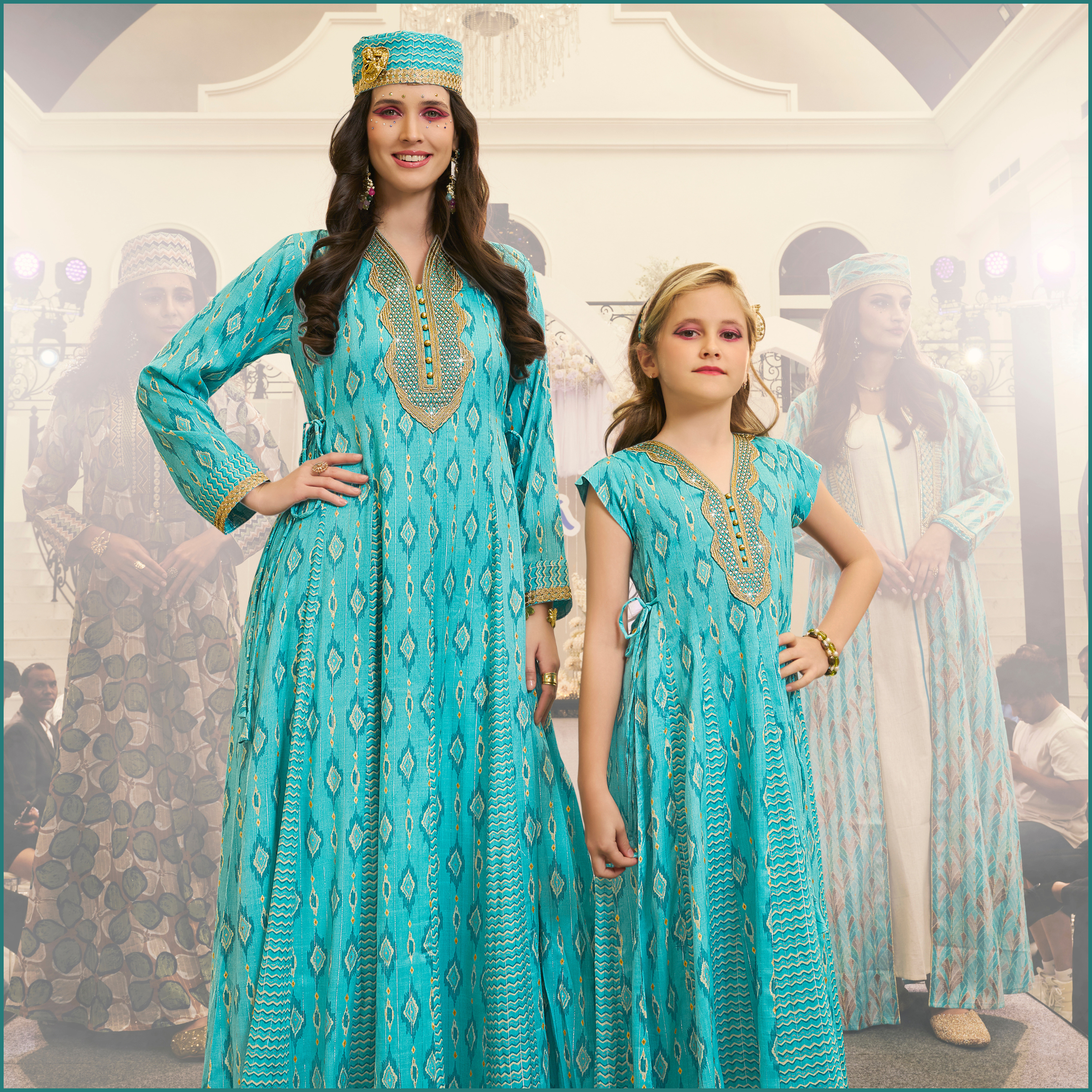
The morning of Eid has a texture. Incense is working its way under bedroom doors. Relatives are arriving before the coffee is ready. And somewhere in the chaos, a small child who needs to look immaculate for the next eight hours of photos, prayers, and feasting.
If you've ever tried to dress an energetic four-year-old in anything with embroidery, you already know the stakes. That's where the right jalabiya dress for kids stops being decorative and starts being practical. Sara's Eid collection was built for exactly this tension - the one between wanting your daughter to look like she stepped out of a heritage painting and needing her clothes to survive a full day of Gulf festive celebrations.
Whether you're shopping from Dubai, Abu Dhabi, or scrolling through kids' jalabiya online from Oman, this guide covers everything: fabric, fit, accessories, and how to get out the door on time.
The modern jalabiya isn't your Grandmother's kaftan
Gulf kids' fashion has shifted noticeably over the past decade, and it's not hard to see why.
Traditional Khaliji designs were made for a slower pace - long gatherings in cooler interiors, with limited movement expected of children who were dressed and told to sit nicely. Contemporary Eid life looks different. Kids run between family gatherings. They eat on their laps. They sit on marble floors for prayers. They fall asleep in the car on the way home and need to be carried inside without waking up.
The modern jalabiya answers that by keeping the cultural vocabulary - the silhouette, the embellishment, the formality - while reworking the construction underneath. Lighter cuts replace structured volume. Elastic panels replace rigid seaming. Arabic jalabiya designs that once required a tailor to put on now slip over a child's head in thirty seconds.
Modern jalabiya styles have also started pulling from a wider set of references - Moroccan tile patterns, Omani silverwork, Indian Zari traditions - creating designs that feel pan-Gulf rather than strictly regional.
For parents who grew up wearing stiff, heavy Eid clothes that they couldn't wait to change out of, that evolution feels personal. The goal was always to look beautiful; now the clothes cooperate with children instead of fighting them.
One thing hasn't changed: the moment you put a well-made jalabiya on a small girl, and she catches a glimpse of herself in the mirror. That reaction is still the same.
What to actually look for: Fabrics, Details, and Fit
Embellishment: what holds up and what doesn't
Metallic threadwork is the workhorse of festive embellishment - it reflects light well, photographs vividly under flash, and when done properly with a locked stitch, stays intact through washing. Sara's pieces use embroidery sourced with thread weights appropriate for children's wear, which sounds like a minor detail until you've watched a cuff unravel mid-Eid-prayer.
Lace detailing at the cuffs or hem reads elegant in photographs but requires more care in practice. Worth it for an older child who can be trusted not to catch it on everything.
The fabric question
UAE and Oman share a problem: the weather doesn't care what holiday it is. Cotton-blend fabrics with a slight stretch are the honest answer for children who will be active. They breathe, they move, they don't show every crease from sitting. Linen-look finishes give a slightly more formal appearance while keeping the same breathability - good for kids who need to look put-together through a long family lunch.
Avoid anything fully synthetic for daytime wear. It photographs fine and looks beautiful on a hanger, but a child in a fully polyester garment at midday in Dubai is miserable within twenty minutes.
Completing the look without overdoing It
The accessories conversation for Eid kids' fashion tends toward excess. Resist it.
A child in a well-embellished jalabiya dress for kids is already doing a lot visually. The outfit is the statement. Accessories should support it, not compete.
For hair, a fabric-wrapped headband in a matching or complementary tone works for most ages. Clips with a single pearl or small crystal are enough. Avoid anything with sharp edges or protruding metal near necklines with threadwork - you'll spend the afternoon separating the two.
For jewellery: one piece, chosen for safety. A small bracelet or a simple pendant on a short chain. Nothing with dangling elements that small hands will pull. Traditional minimalist jewellery in gold or silver tones reads correctly with most Arabic jalabiya designs without overwhelming the garment.
Footwear matters more than people expect. The shoes will be removed multiple times - for prayers, for entering homes, for climbing things they shouldn't. Embellished flat sandals with a secure ankle strap are the practical answer. They photograph beautifully and come on and off without a struggle. If you're committed to a small heel, a block heel of under three centimetres on an older child is the outer limit of what makes sense for a long day.
The night-before checklist for parents who hate morning chaos
Eid morning is not the time to discover that the outfit needs steaming, the shoes don't fit, or the clip you planned to use is missing. Do these the evening before:
Steam the jalabiya hanging, not flat. Cotton-blend and linen-look fabrics respond well to vertical steaming. Ten minutes the night before means no creases at 7 am.
Test the full outfit together. Put the shoes with the dress. Put the headband with the outfit. Check that nothing catches or pulls. If a cuff snags on a hair accessory in your bedroom, it will definitely snag during prayers.
Set out everything in order. Outfit, shoes, accessories, all in one place.
Dress children after breakfast, not before. This is non-negotiable. The probability of something landing on white embroidery during breakfast is essentially 1.
Keep a small lint roller and a stitch pen nearby. Gulf morning light shows everything. A sixty-second check before leaving the house is worth it.
Do hair before the outfit goes on. Pulling anything over an already-done hairstyle is optimistic.
If you've spent time choosing a well-made jalabiya dress for kids, take two minutes to photograph it properly. It costs nothing.
Golden hour - the forty-five minutes after sunrise and before sunset - does something specific for metallic threadwork. The embroidery picks up warm light and reads as dimensional rather than flat. If you're photographing indoors, position near a window rather than using flash; direct flash washes out the embellishment detail.
Candid moments photograph better than posed ones with children. Wait for the moment your daughter is talking to a cousin, or looking at something outside, or straightening her own sleeve. That's the photograph. The stiff, posed version will always look like a stiff, posed version.
For group family photos: coordinate by tone rather than matching. Three children in different shades of the same colour family - dusty rose, blush, ivory - look intentional and allow each garment to read on its own. Three children in identical outfits look like a product listing.
A note on keeping heritage without keeping it precious
Eid clothes get worn. They should get worn. The goal isn't to keep a jalabiya pristine in a wardrobe - it's to have a child remember wearing something beautiful on a day that mattered.
Sara's kids' collection is built around that idea: garments that hold up to a real Eid, look right in every photograph from that day, and wash correctly afterward. Browse the current Eid range for the full selection of kids' jalabiya online, including Dubai and Oman delivery options.
FAQs
Q: What makes a modern jalabiya different from traditional designs?
The most practical difference is construction. Traditional garments often used heavier fabrics, structured seaming, and embellishment techniques that required careful handling. A modern jalabiya keeps the visual language - the length, the embellishment placement, the Khaliji silhouette - but uses lighter fabrics, simplified closures, and embroidery techniques that withstand regular washing. Arabic jalabiya designs today also incorporate a wider range of colour and pattern references than the more standardised regional palettes of older styles.
Q: How should I wash a jalabiya dress for girls with metallic embroidery?
Turn the garment inside out. Cold water, gentle or delicate cycle, mesh laundry bag. Do not wring. Lay flat or hang to dry away from direct sun - UV fades both the fabric colour and the metallic thread over time. Do not tumble dry. If the piece has significant Zari embroidery panels, hand-washing those sections specifically is worth the extra five minutes. Most quality metallic threadwork is sewn with a locked stitch and survives careful machine washing; it's heat and agitation that cause damage, not water.
 Free Shipping
 Delivery on time
 100% Secure Payment
Copyright © All right reserved Sara Arabia (SARA PLAZA GEN. TRAD. & CONT. CO. WLL.).


Leave a Comment
Please note, comments must be approved before they are published