


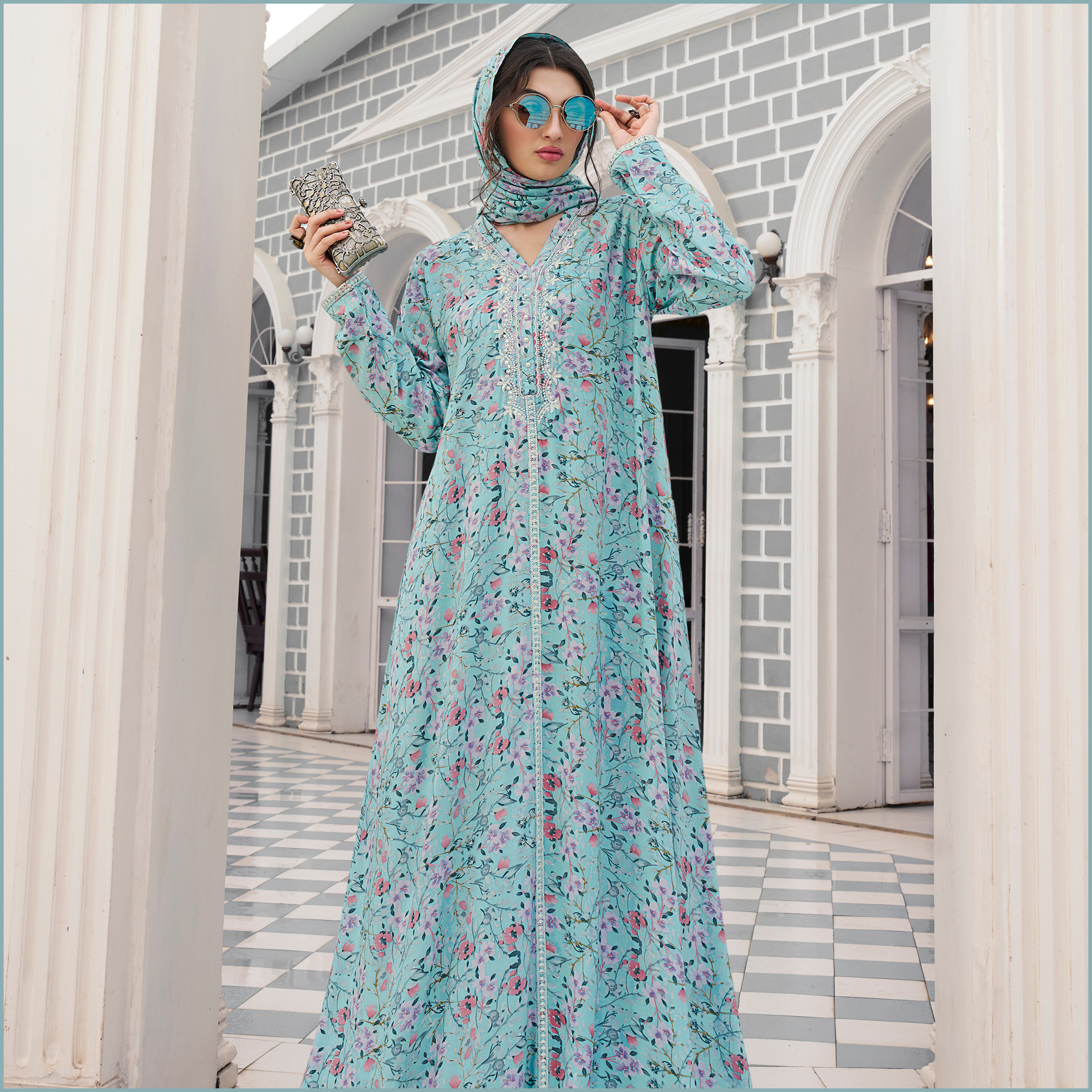
There is a particular kind of relief that comes with slipping into a jalabiya on a June afternoon in Abu Dhabi. The fabric falls loose, the air moves freely, and for a moment you are dressed precisely right for the world you inhabit. The jalabiya understood Gulf summers centuries before anyone coined the phrase "breathable fashion." This year, more women across the UAE and Oman are treating it not as something to wear around the house, but as the arabic lady dress they reach for first. School run, family lunch, late evening gathering - same jalabiya.
What makes the jalabiya the ideal summer Arabic dress
The jalabiya works because of how it is cut. Fitted Western silhouettes press fabric against skin and trap heat. The jalabiya does the opposite: it creates a column of moving air between body and cloth. Wide sleeves, generous hem. These are practical choices, not decorative ones, inherited from women who dressed for desert heat long before air-conditioned malls existed.
Among arabic dresses for women, this quality belongs to the jalabiya specifically. The abaya is outerwear, layered over clothing. The kaftan, while similarly loose, sits heavier across the shoulders. The jalabiya is a complete outfit on its own, and it works indoors and out without feeling like a compromise.
When Dubai and Muscat reach 45 degrees or higher between June and August, that difference in weight and airflow stops being abstract. Sara's summer pieces follow the same logic: cut wide enough to move freely, made light enough that you forget you are wearing structured clothing.
Summer fabrics that actually work in Gulf humidity
Not every lightweight fabric survives Gulf humidity. Cotton breathes well but absorbs moisture and can feel damp by midday. Cotton voile, woven sheer enough to release heat fast, keeps a crisp drape without that weight. Linen blends add the softness of viscose, which takes the stiffness out of pure linen. Lightweight crepe (particularly Japanese or French weaves) has a matte finish that resists the sheen humidity gives to satin and silk.
If a jalabiya clings to your arms within an hour, the fibre content is probably synthetic-heavy regardless of the label. Polyester blends marketed as "summer-ready" overheat within minutes in real Gulf conditions. This can be seen happening at outdoor events in Ras Al Khaimah where women in polyester-blend jalabiyas looked visibly uncomfortable by the second hour, while those in natural fibres barely noticed the heat.
Sara's summer collections prioritise natural and semi-natural fibres because a jalabiya UAE women wear daily must work in actual weather, not on a mannequin in a cooled showroom. The hand of the fabric tells you more than any product description. Cool, slightly textured cloth with a loose grain is right for summer. Slippery, dense cloth is not.
Colour and print choices for Gulf summers in 2026
Summer 2026 brought a noticeable shift in jalabiya colour preferences. The iced pastels from Ramadan (pistachio, powder blue, blush) have carried into daily wear, but women are pairing them with deeper accent embroidery instead of tone-on-tone stitching. A pistachio jalabiya with navy thread at the neckline reads cooler than an all-pastel piece. It also reads more deliberate, like someone chose it rather than defaulted to it.
For evening gatherings and weekend visits, saturated colours hold. Deep teal, burnt umber, oxblood. These have replaced the safer blacks and navies that used to dominate after-dark wardrobes. They photograph well under the warm lighting common in Emirati and Omani homes, which is where most Gulf summer socialising happens anyway.
Prints remain polarising. Geometric motifs inspired by Islamic tilework continue to sell in the UAE, particularly on cotton jalabiyas for casual wear. Large florals feel more Kuwaiti in sensibility. Sara's current summer edit leans geometric, with angular patterns that stay sharp after repeated washing. That last point gets overlooked when choosing prints. A pattern that bleeds or softens after five washes was not worth selecting.
How to spot a quality jalabiya when shopping online
Buying a luxury jalabiya online requires looking past the product copy.
Start with the photographs. A quality piece will be shown on a model or dress form, where you can see how the fabric falls at the hem and sleeves. Stiff and board-like means the cloth is too heavy or overly starched. Puddles without structure mean they may lack the body to drape on an actual person.
Next, seam finishes. French seams (raw edges enclosed within the seam itself) are a mark of careful construction. Overlocked edges are standard mid-range. Raw, unfinished edges mean mass production.
Then embroidery. Hand-embroidered pieces, still common among Gulf ateliers, show slight irregularity in stitch spacing. That unevenness is the human part. Machine embroidery is perfectly uniform and sits flat, while hand-stitched threadwork has subtle dimension. Neither is inherently better, but knowing which you are paying for prevents disappointment.
Sara includes close-up embroidery photography in its online listings so you can make this assessment before buying.
One jalabiya, many moments
Here is what a single day in midsummer Sharjah actually looks like in a jalabiya.
Morning: you are making breakfast in a cotton voile jalabiya, sleeves pushed back, bare feet on cool tile. It moves with you between kitchen and living room without snagging.
Mid-morning: a friend stops by. You do not change. You are already presentable enough to sit on the sofa, drink Arabic coffee, and look pulled together without having planned for company.
Afternoon: the children need collecting from summer camp. Sandals on, bag grabbed, out the door. The jalabiya works at the school gate, the petrol station, the car. No second glance, no costume change.
Evening: family dinner at your sister's. Swap the cotton voile for a crepe jalabiya with geometric embroidery at the cuffs. Different sandals, heels this time, and a single gold cuff. Five minutes.
No other arabic lady dress moves through a day like this without friction. The jalabiya does not segment your life into outfit changes. It just comes with you.
Building a summer jalabiya collection that lasts
You do not need fifteen jalabiyas for summer. Three to five, chosen carefully, will cover everything.
Two daily-wear pieces in breathable cotton or linen blend. One neutral, one in a colour you actually like wearing repeatedly (not a colour you liked on the hanger). One mid-weight crepe jalabiya in a richer shade with embroidery, for evenings. If your calendar includes formal summer events, add a fourth in refined fabric with hand-finished detailing.
Think cost per wear, not sticker price. A quality jalabiya from Sara, made in natural fibres with finished seams and colourfast dyes, will look the same after many washes. A cheaper alternative may cost a third as much but last one season before the embroidery loosens or the fabric pills. Gulf women who wear jalabiyas more frequently than any other garment have understood this arithmetic for a long time. It is not a luxury strategy. It is a practical one.
FAQs
What is the best fabric for a summer jalabiya in the UAE?
Cotton voile and linen blends. They release heat quickly, resist clinging, and hold their shape through repeated washing. For evenings, lightweight crepe.
Can I wear a jalabiya on its own in summer?
Yes. The jalabiya is a complete garment, unlike the abaya, which is outerwear layered over clothing.
How do I keep a lightweight jalabiya looking new?
Gentle cycle at 30 degrees, or hand-wash. Skip fabric softener on embroidered pieces. Dry in shade, not direct sun. Iron on low or steam.
Where can I buy a luxury jalabiya online with reliable quality?
Look for retailers that show close-up construction details, specify fibre composition, and photograph garments on dress forms rather than flat-lay only. Sara's online store includes embroidery close-ups, full fabric descriptions, and fit guidance for each piece.
What is the difference between a jalabiya and a kaftan for summer?
The jalabiya is narrower, designed for daily indoor-outdoor wear. The kaftan is wider, often more ornamented, and better suited to occasions. For summer daily use, the jalabiya wins on practicality.
The jalabiya as a summer constant
Every wardrobe has a garment that earns its place through repetition, not spectacle. For Gulf women, that has been the jalabiya for longer than any trend cycle. What changed in 2026 is not the jalabiya itself but how women shop for it: paying closer attention to fabric, seam quality, and whether a piece will still look good in October.
If your summer wardrobe needs one addition, make it a well-made jalabiya in a fabric that suits your actual days. Then see how often you reach for it.
 Free Shipping
 Delivery on time
 100% Secure Payment
Copyright © All right reserved Sara Arabia (SARA PLAZA GEN. TRAD. & CONT. CO. WLL.).


Leave a Comment
Please note, comments must be approved before they are published